

The Bridging visa B “switcheroo”: staying in Australia while an offshore Partner visa is decided

If you are in Australia on a bridging visa and your partner is Australian, you may have heard about the Bridging visa B “switcheroo”. It is a sequence of two short trips and two Bridging visa B (BVB) grants that can leave you living lawfully in Australia while an offshore Partner visa (subclass 309/100) is processed. It is fully legal and uses the bridging visa rules exactly as they are written. It also only suits some people, and the timing has to be right. Here is how it works, based on the law as at 19 November 2026.
Who it helps
The typical person is in Australia on a Bridging visa A (BVA) because an onshore visa application, or an ART review of a refusal, is still open. They are in a genuine relationship with an Australian citizen, permanent resident or eligible New Zealand citizen, and they want to apply for a Partner visa.
Applying onshore for a Partner visa (subclass 820/801) is not always the best option. For example, extra Schedule 3 criteria apply to people who do not hold a substantive visa when they apply, and a “no further stay” condition can stop an onshore application altogether. The offshore 309/100 avoids those problems, but you must be outside Australia when you lodge it. The switcheroo is a way to lodge it from outside Australia on a short trip, then come home and stay covered while it is decided.
The rules that make it work
- You can only get a BVB in Australia. You must be in Australia, and hold a BVA or BVB, when you apply and when it is granted.
- Most BVBs are tied to an onshore application. The usual rule is that the BVB relates to an application you made in Australia for a visa that can be granted in Australia.
- Partner visas have their own rule. A BVB can also be granted while you have a Partner (Migrant) visa application (the subclass 100 part of a 309/100) that has not been finally determined. This rule does not say the partner application must have been made in Australia. That is the key to the whole strategy.
- The 309/100 is lodged from outside Australia. You, and every family member applying with you, must be outside Australia when it is lodged. Both the 309 and the 100 can be granted while you are in Australia.
- A new bridging visa replaces the old one. When the second BVB comes into effect, the first one ends.
Each BVB also needs a substantial reason to leave and come back, and Home Affairs must be satisfied of that reason. The charge is $575 per application (lower for eligible Pacific Island and Timor-Leste citizens).
Step by step

- BVB 1, linked to your onshore matter. While your onshore application or ART review is open, apply for a BVB with a genuine, substantial reason to travel, such as a family wedding or a parent’s illness, and evidence of it. Home Affairs recommends applying 2 weeks to 3 months before you travel. If your matter is at review, the BVB is applied for by webform rather than in ImmiAccount.
- Trip 1: lodge the Partner visa offshore. Travel on BVB 1. Once you, and anyone applying with you, are outside Australia, lodge the 309/100 online. Then return before BVB 1’s travel period ends.
- BVB 2, linked to the Partner visa. Back in Australia, apply for a second BVB through the Partner visa application in ImmiAccount, with a new, genuine reason for a later trip. You still hold BVB 1, so you meet the “hold a BVA or BVB” rule.
- BVB 2 takes over. Once BVB 2 is granted it replaces BVB 1, and it lets you stay until the Partner visa is decided (or, if it is refused, until 35 days after the refusal or after the ART decides a review).
Worked example (names invented). Leila’s student visa extension was refused and she applied to the ART on time, so her BVA continues. She marries Tom, an Australian citizen. In February she applies for BVB 1 to attend her sister’s wedding overseas in March, and it is granted with a travel period to 30 April. In March, while overseas, she lodges a 309/100 online, then flies home on 20 March. In May she applies for BVB 2 through the Partner visa application, to attend her father’s 70th birthday in August. BVB 2 is granted in June while her ART review is still open. From then on, BVB 2 keeps her lawful in Australia with Tom until the Partner visa is decided, and she can decide with her lawyer whether to continue the ART review.
The timing traps
- Your onshore matter ends too early. BVB 1 ends 35 days after a refusal, a withdrawal or an ART decision, and you cannot re-enter on it after that. You must still hold BVB 1 when BVB 2 is decided. If the ART decides your review while you are overseas, or before BVB 2 is granted, you can be stranded offshore or left without a visa.
- Lodging before you leave. If anyone on the 309/100 application is still in Australia when it is lodged, it is not valid. Lodge only once you are all overseas.
- Missing the travel period. If you are outside Australia when your BVB travel period ends, the BVB ceases and you cannot come back on it. Home Affairs cannot extend the travel period after grant.
- BVB 2 attached to the wrong application. BVB 2 must be applied for against the Partner visa application. A BVB processed against your onshore matter will not keep you covered once that matter ends.
- Withdrawing the onshore matter too soon. A withdrawal starts the 35-day clock on BVB 1. Wait until BVB 2 is granted, then decide with advice.
- Weak or untrue travel reasons. Every BVB is assessed on its own reason and evidence. Be truthful: false or misleading information can lead to refusal or cancellation.
Could it work for you?
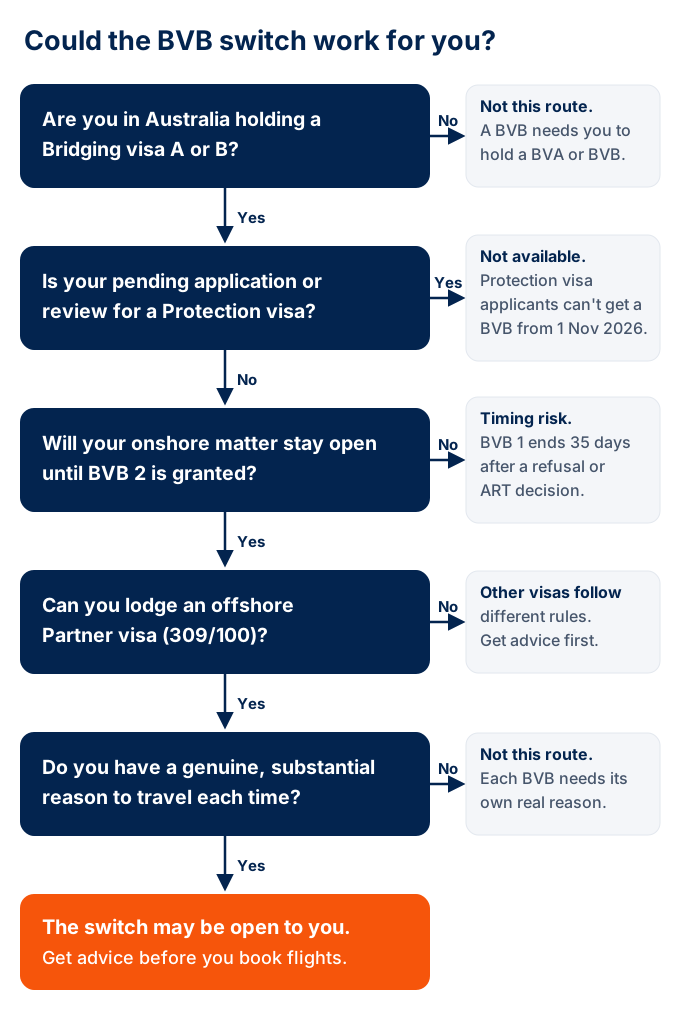
It does not work if you are in Australia on a visitor visa only, or on a Bridging visa C or E, because a BVB can only be granted to someone who already holds a BVA or BVB. It is also closed to Protection visa applicants: since 1 November 2026, anyone with a Protection visa application, review or judicial review still open cannot apply for or be granted a BVB. And it does not make a weak partner case stronger. The 309/100 is assessed on the usual partner criteria.
Do
- Check in VEVO that you hold a BVA or BVB before you start.
- Plan around how long your onshore matter is likely to stay open.
- Have the 309/100 ready to lodge before trip 1.
- Give a real reason and evidence for each trip.
- Keep every travel period date in your calendar.
Don’t
- Lodge the Partner visa while anyone applying is still in Australia.
- Leave Australia before a BVB is granted.
- Withdraw your onshore matter before BVB 2 is granted.
- Rely on a visitor visa, BVC or BVE for this route.
- Overstate why you need to travel.
Frequently asked questions
Is the BVB switcheroo legal?
Yes. It follows the Migration Regulations as written. It does not skip any assessment: each BVB must meet every criterion, including a substantial reason to travel, and the Partner visa is assessed in the usual way.
Can I do it if I am on a visitor visa?
No. You must hold a Bridging visa A or B when you apply for a BVB. A visitor visa, a Bridging visa C or a Bridging visa E does not qualify.
Do I have to leave Australia for the 309 to be granted?
No. Since 25 November 2023 a subclass 309 can be granted while you are in or outside Australia. You only need to be outside Australia when you lodge the application.
What happens if BVB 2 is refused?
You keep BVB 1 for as long as it lasts, and a refused bridging visa does not trigger the section 48 bar on further applications. But BVB 1 still ends 35 days after your onshore matter is decided, so get advice straight away about your options.
I have applied for a Protection visa. Can I use this?
No. Since 1 November 2026, Protection visa applicants (including those at review or judicial review) cannot apply for or be granted a BVB. BVB applications lodged before that date are still being processed.
Plan it with Rise before you book
The switcheroo works well when the dates line up, and badly when they don’t. A Rise lawyer can check whether you qualify, map out your onshore matter’s likely timing, prepare both BVB applications and the 309/100, and tell you if another pathway is stronger. Book a consultation, or read more in our guides to bridging visas A, B, C and E, onshore vs offshore Partner visas and your options after a refusal, and on our Partner visa (309/100) and partner and family pages.
Sources
- Federal Register of Legislation, Migration Regulations 1994 (compilation No. 291, 3 November 2026): Schedule 1 items 1129, 1220A and 1302; Schedule 2 clauses 020.211 to 020.224, 020.411, 020.511, 100.411, 309.412 and 820.211; regulation 2.12, checked 19 November 2026.
- Federal Register of Legislation, Migration Amendment (2026 Measures No. 1) Regulations 2026 and explanatory statement (Bridging visa B changes from 1 November 2026), checked 19 November 2026.
- Federal Register of Legislation, Migration Act 1958 (compilation No. 172, 8 October 2026): sections 11A, 48 and 82, checked 19 November 2026.
- Department of Home Affairs, Bridging visa B (subclass 020) (last updated 9 November 2026) and Travel on a bridging visa, checked 19 November 2026.
- Department of Home Affairs, Partner (Provisional) visa (subclass 309) (last updated 5 November 2026), checked 19 November 2026.